In the Houston metropolitan area, severe weather is a part of life. While we often focus on the wind of a hurricane, it is the hail from spring thunderstorms that causes the most cumulative damage to Texas properties. Every year, billions of dollars in insurance claims are filed due to hail—yet thousands of homeowners miss the signs, leading to massive out-of-pocket costs years later when the roof finally fails.
As experts in Hail Damage Roof Repair, All Over Exterior Roofing wants to empower you with the knowledge to spot damage before it turns into a disaster.
1. The Science of Hail Damage: Why It’s Not Just a Dent
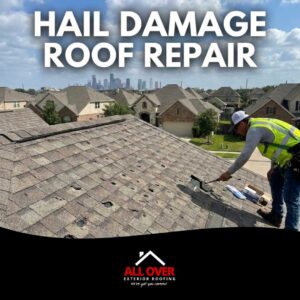
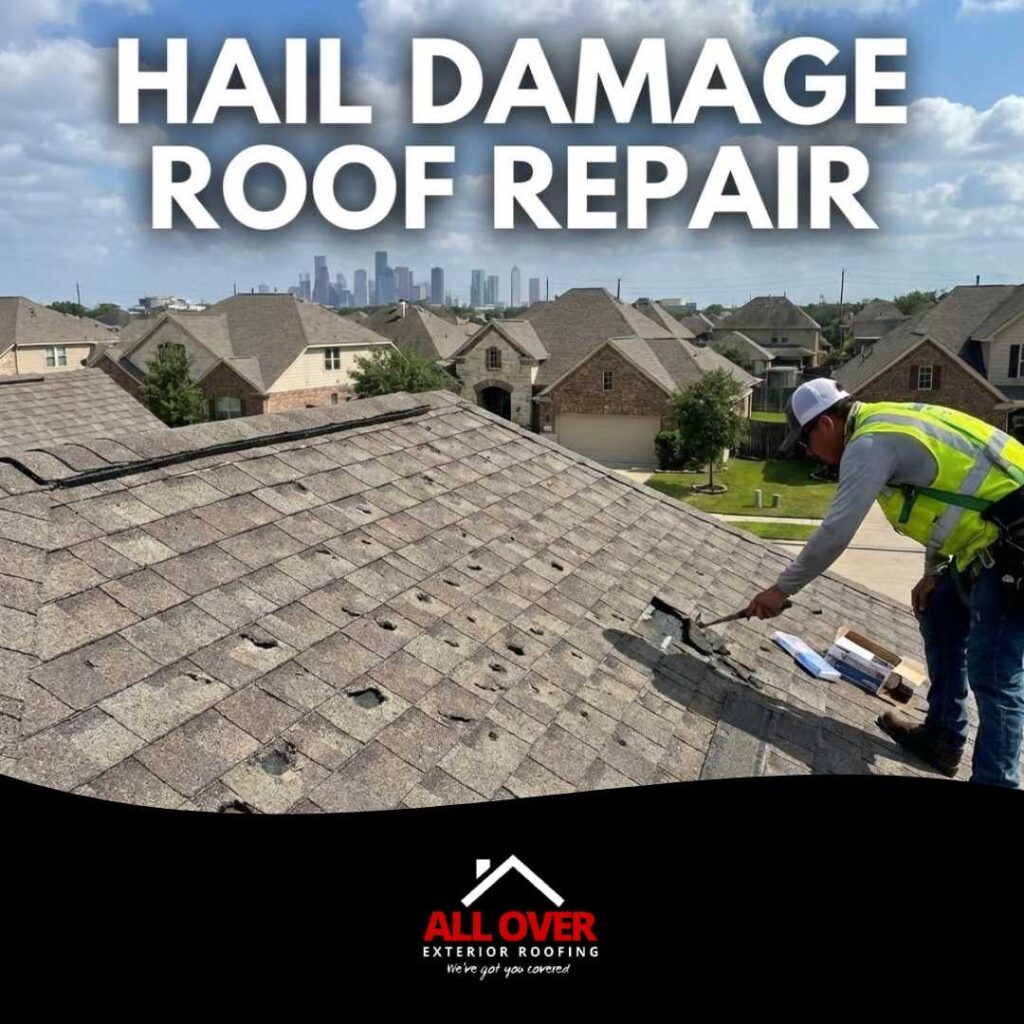
When a hailstone—even one as small as a marble—hits an asphalt shingle at terminal velocity, it creates a “bruise.” This impact does three things:
-
- Dislodges Granules: The protective ceramic granules are knocked off, exposing the underlying bitumen (asphalt).
-
- Fractures the Fiberglass Mat: The structural core of the shingle can crack, even if the surface looks “okay.”
-
- Accelerates UV Decay: Once the granules are gone, the Texas sun “bakes” the exposed asphalt, causing it to become brittle and leak within 6 to 12 months.
2. Five Signs You Need an Immediate Inspection
If a storm has recently hit your area (check local weather apps like KHOU 11 or Space City Weather), look for these indicators:
Sign #1: The “Sand” in the Gutters
If you find a heavy accumulation of granules in your gutters or at the end of your downspouts after a rain, your shingles have been compromised. This is the #1 sign of high-velocity impact.
Sign #2: Dents on “Soft Metals”
Check your roof vents, chimney flashings, and aluminum gutters. Metal shows impact much more clearly than shingles. If there are dings in the metal, there is almost certainly damage to the shingles.
Sign #3: Missing or Misaligned Shingles
High winds often accompany hail. If you see shingles on your lawn or “tabs” that are lifted and flapping, the seal has been broken. Once the adhesive seal is compromised, your roof is vulnerable to “wind uplift” in the next storm.
Sign #4: Cracks in the Siding or Fences
Look at your home’s exterior. If the hail was strong enough to chip the paint on your fence or crack your vinyl siding, it was strong enough to destroy your roof’s waterproofing layer.
Sign #5: Interior Leaks and Water Spots
This is the final stage. If you see brown spots on your ceiling, the water has already bypassed the shingles, the underlayment, and the wood decking. You are now in an Emergency Roof Repair situation.
Don’t wait for a leak.
Schedule a professional storm damage assessment now.
3. The “The Guardian” Strategy: Protecting Your Family and Finances
For our primary audience—the homeowners who manage the safety of their families—hail damage is a financial risk. In Texas, you typically have a one-year window to file an insurance claim after a storm. If you wait until the roof starts leaking two years later, your insurance company will likely deny the claim, citing “lack of maintenance.”
By acting now, you can often get a full roof replacement for only the cost of your deductible.
4. Why Online Reviews Matter in Storm Recovery
After a major storm, “Storm Chasers” flood Houston neighborhoods. They promise “free roofs” and offer to “waive the deductible” (which is actually illegal in Texas under HB 2102).
Always check a contractor’s local reputation. Does the company have a physical office in Houston? Are they highly rated on Google by people in your community?
Posted onTrustindex verifies that the original source of the review is Google. I contacted the team and they were able to replace my garage roof the same week. Very quick and punctual. I am a very satisfied customer and would recommend their service.Posted onTrustindex verifies that the original source of the review is Google. From start to finish, All Over Roofing was easy to work with. They were prompt, responsive, and professional every step of the way. Every question I had, no matter how small, was answered quickly and thoroughly. They also worked with me to negotiate a fair contract at a competitive price. When it came time to do the job, their crew showed up on time and knocked it out in one day, efficient and well-organized. They came back the next day to take care of every punch list item I noticed without hesitation. I’m grateful for their hard work and professionalism, and I wouldn’t hesitate to recommend them to anyone in need of roofing or general contracting work.Posted onTrustindex verifies that the original source of the review is Google. Julio and his team did an excellent job for us. We had him replace old siding, rewrap and stain 30 columns and pressure wash a large porch area. Julio quoted a fair price, communicated well during the process and his team was respectful of our property.Posted onTrustindex verifies that the original source of the review is Google. Nothing but good things to say about Julio and his team. We had to do a full siding replacement for our house due to age and a critter clawing through a rotted spot. Julio and his team were able to recreate the style we requested, replace all of the fascia, soffits, and gutters, and painted the house. Our house looks great and the work of Julio and his crew have greatly enhanced its curb appeal. Will definitely be using them in the future when it is time to replace the roof :-)Posted onTrustindex verifies that the original source of the review is Google. We had a great experience with Julio and his crew. We needed a new roof to close the sale of our house and Julio responded quickly with a bid and immediately started the work. He scheduled a large enough crew to get the job done quickly and took great care that there was no damage to plants or trash left in the pool or yard. We highly recommend All Over Exterior Roofing.Posted onTrustindex verifies that the original source of the review is Google. I needed a full roof replacement and got quotes from several contractors. Julio got back to me quickly with a detailed estimate at a reasonable price. Communication was great, they were happy to answer all of my questions about the different options, and were able to get me on the schedule quickly. The crew showed up on time, finished earlier than expected, and left the area erring the house clean. The new roof looks great, would definitely recommend All Over Exterior Roofing.Posted onTrustindex verifies that the original source of the review is Google. Crew arrived on time and finished by 3pm same day. High quality work. The Crew Lead was available and explained the process, also answered all my questions satisfactorily. Excellent execution overall.Posted onTrustindex verifies that the original source of the review is Google. Outstanding service by Julio and his team from the initial meeting to installation to final cleanup! Highly recommend!Posted onTrustindex verifies that the original source of the review is Google. Great work, exceptional service. Full engagement, with great advice on dealing with insurance and providing information on the best practices concerning roof replacement.Posted onTrustindex verifies that the original source of the review is Google. Excellent delivery of work, giving due care and attention to the work on our historic home in Montrose. The crew were very responsive and respectful, and they kept us informed on progress or any problems requiring attention. I highly recommend All Over Exterior Roofing.
5. How to Successfully File a Roof Insurance Claim in Houston
Navigating insurance can feel like a full-time job. Here is our expert advice:
-
- Document the Date: Know exactly when the storm occurred.
-
- Call a Roofer FIRST: Most insurance adjusters are overworked after a storm. Having a professional roofer present during the adjuster’s inspection ensures that all damage is properly identified and documented.
-
- Review Your Policy: Understand the difference between ACV (Actual Cash Value) and RCV (Replacement Cost Value). RCV policies are much better for homeowners as they cover the full cost of the new roof.
6. Repair vs. Replacement: What’s Best?
If the damage is localized (e.g., only one slope was hit), a Roof Repair might be sufficient. However, if more than 25% of the roof is affected, most Houston building codes and insurance carriers will favor a full replacement to ensure the structural integrity of the home.
Conclusion: Your Home Deserves the Best Defense
Houston’s weather isn’t getting any milder. A hail-damaged roof is a ticking time bomb. By identifying the damage early and working with a trusted, local professional, you can secure your home and your family’s peace of mind.
Think you have storm damage? Let our experts provide a 100% transparent Digital Inspection.